Executive Assistant Career Levels Guide
Executive Assistants, Career Growth, Leadership
Executive Assistant Career Levels: Where Are You Really?
Discover the real career levels for executive assistants and find out where you actually stand – plus a free Career Ascension Map tool that helps you diagnose your current level and your next move.
Executive Assistant Career Levels: Where Are You Really?
Two executive assistants both carry the title "Senior EA." One manages a VP's calendar, coordinates team lunches, and handles travel. The other runs board-level operations for a CEO, manages a direct report, leads cross-functional projects, and serves as the de facto chief of staff without the title or the pay. Same job title. Entirely different career levels. This is the uncomfortable truth the EA profession rarely confronts: job titles in this field are nearly meaningless as indicators of career level, and that gap directly affects your compensation, your trajectory, and how leadership perceives your value. If you've ever felt like your title doesn't reflect what you actually do, you're probably right — and you're not alone.
What Most EAs Don't Know About Career Progression
The EA profession doesn't have a universally recognized career ladder. Unlike finance, engineering, or even HR — where titles map to clear competency bands and compensation tiers — executive assistant roles are defined by whatever each organization decides they mean. That's why "Senior EA" can describe a $65K role at one company and a $105K role at another.
This creates a real problem for career development: if your organization hasn't defined EA career levels internally, you have no roadmap. No criteria for promotion. No language to distinguish between doing more work and operating at a higher level. And because most EAs are too embedded in daily operations to step back and assess their own trajectory, the default becomes tenure-based advancement, which isn't advancement at all. It's just time passing.
The profession's history of being undervalued compounds this. When organizations don't invest in defining EA career paths, the implicit message is that there's nowhere to go. That's not true. But without a framework, it feels true.
What the Data Actually Says
Career progression for executive assistants follows a general trajectory, though the specifics vary by organization and industry. The typical path moves through five levels: Administrative Assistant, Executive Assistant, Senior Executive Assistant, Executive Business Partner, and Chief of Staff.
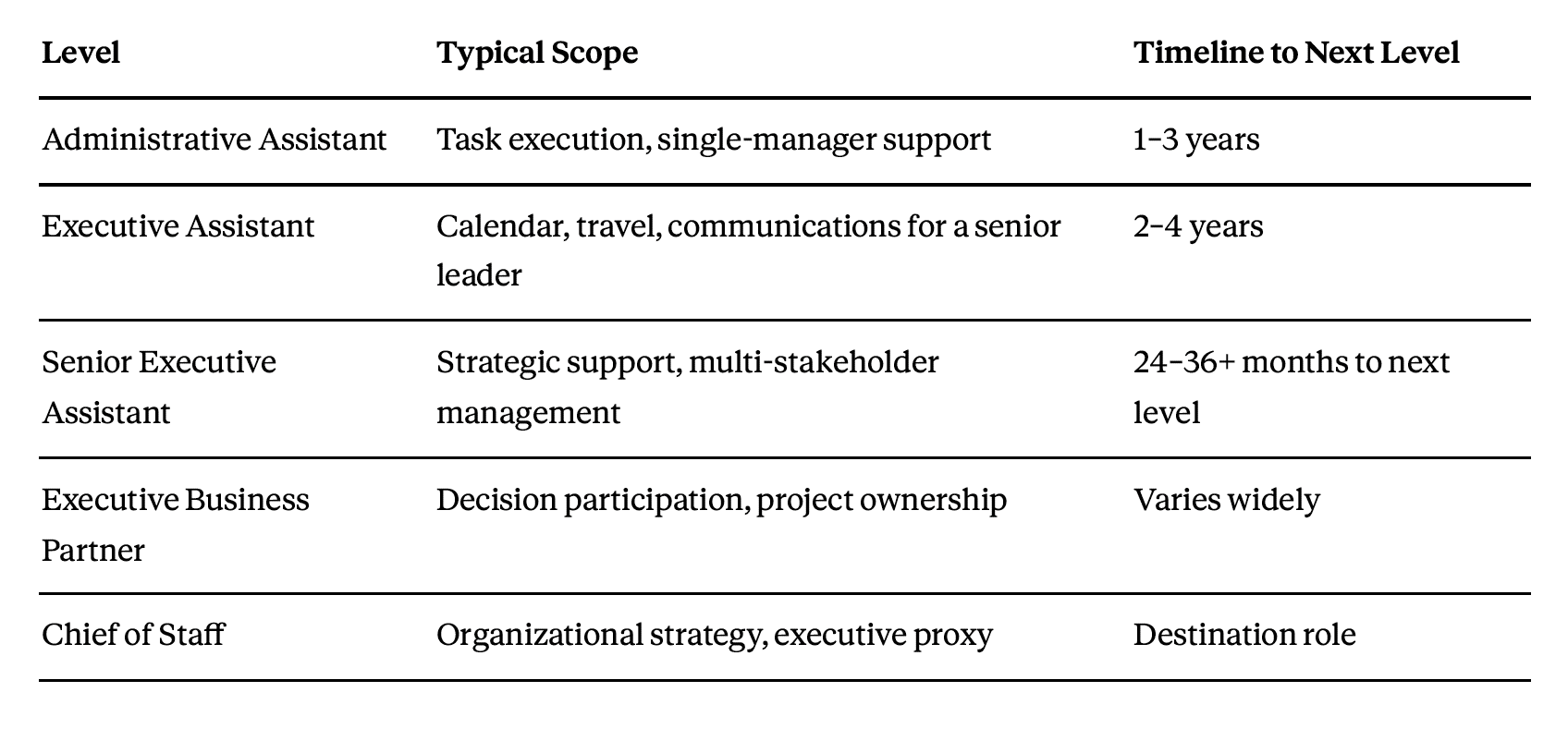
Research from DonnaPro indicates that the jump from mid-level to Senior EA typically requires a minimum of 24 to 36 months — but the timeline alone isn't what matters. What matters is what happens during that time.
Here's the data point that should concern you: most EAs plateau at the Senior EA level. Not because they lack capability, but because career levels are rarely defined in their organizations. Without clear criteria for what "Executive Business Partner" or "Chief of Staff" looks like, there's no promotion path to pursue. The EA-to-Chief-of-Staff pipeline is real and increasingly recognized — but it requires deliberate positioning, not just time in role.
The 5 Dimensions of EA Career Level
Career level isn't determined by your title or your tenure. It's determined by five dimensions that reflect how you actually operate within your organization. This is the framework that separates a high-performing EA from one who is genuinely operating at the next level.
1. Scope of executive access. Who you support matters, but how you access them matters more. At lower career levels, access is transactional — you interact with your executive to execute requests. At higher levels, you have standing access to strategic conversations, decision-making meetings, and confidential information. You're in the room, not outside it.
2. Strategic involvement. Are you in decisions, or just executing them? At the Senior EA level and above, the distinction is whether you're contributing to strategic direction or simply implementing it. Do you influence meeting agendas, flag risks, or shape how information reaches your executive? If yes, you're operating above the level your title probably reflects.
3. Organizational visibility. At early career levels, your work is visible primarily to your executive. As you advance, your contributions become visible across the organization — to other executives, to the board, to external stakeholders. If senior leaders outside your direct reporting line know your name and your work, your career level is higher than your org chart suggests.
4. Autonomy and initiative. Lower-level EA work is reactive: you're told what to do, and you do it well. Higher-level EA work is proactive: you anticipate needs, create systems, and make judgment calls without waiting for direction. The degree to which you operate independently — making decisions your executive trusts without review — is one of the clearest indicators of your real career level.
5. External professional brand. This is the dimension most EAs neglect entirely. At the highest career levels, your reputation extends beyond your current role. You're known in professional networks, industry groups, or EA communities. You're sought out for advice, mentorship, or speaking. Your brand becomes a career asset that exists independently of your employer.
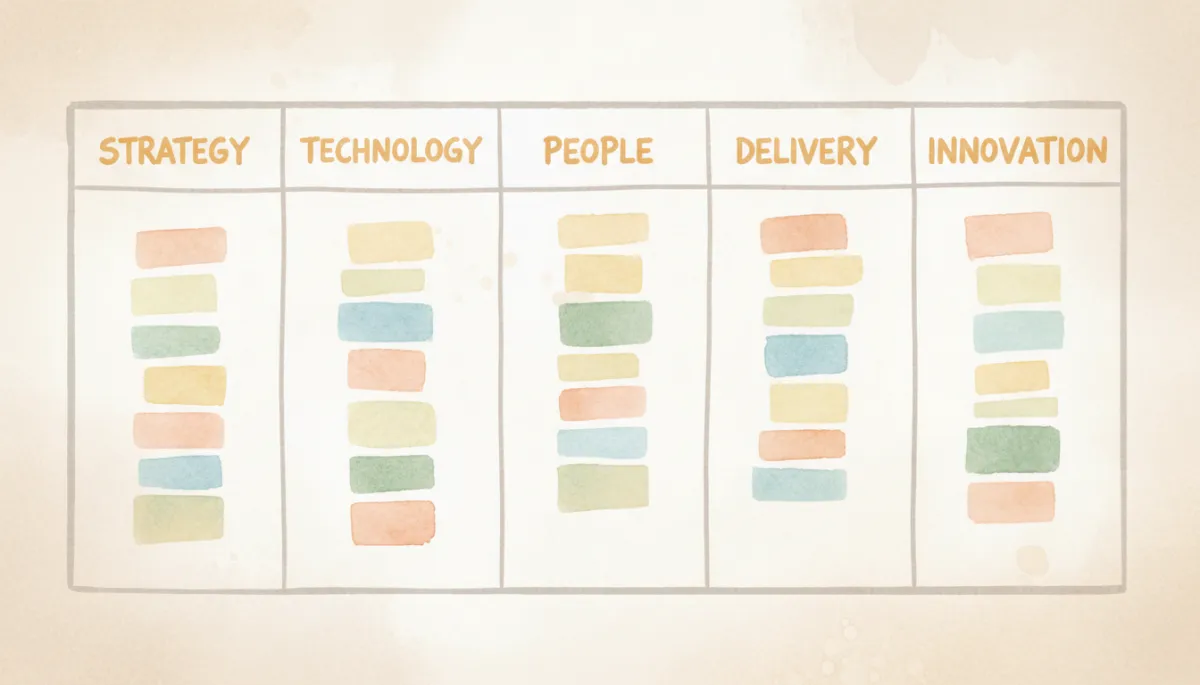
Visualizing the five EA dimensions makes it easier to see where you truly operate.
This Is the Gap the Career Ascension Map Was Built to Close
Most EAs can feel the gap between where they are and where they should be — but they can't define it precisely enough to close it. The Career Ascension Map evaluates your current position across all five dimensions and maps you to a specific career level — not based on your title, but based on how you actually operate. It also identifies which dimension is holding you back and what the next move looks like. This isn't a career quiz. It's a diagnostic built for EAs who are done guessing and ready to see exactly where they stand.
Use the Career Ascension Map →
How to Use Your Results
Your ascension map results show you where you are, where the gaps are, and what closing them requires. Here's how to act on that.
First, identify the dimension gap holding you back. If your results show high strategic involvement but low organizational visibility, your next move isn't to do more strategic work — it's to make the strategic work you're already doing visible. That might mean requesting a seat in cross-functional meetings, presenting updates to senior leadership directly, or building relationships outside your immediate executive's orbit.
Second, build a case for reclassification, not just promotion. If your Career Ascension Map shows you're operating one or two levels above your title, you don't just need a raise — you need a title and role reclassification. Bring your results alongside your market value data to your manager with a clear proposal: "Based on the scope of my current work, I'm operating at the Executive Business Partner level, and I'd like to formalize that with a title and compensation adjustment."
Third, build toward the next level intentionally. If your results show you're solidly at the Senior EA level but not yet at Executive Business Partner, your map will tell you exactly which dimensions to develop. If it's autonomy, start making more decisions without seeking approval and track the outcomes. If it's external brand, invest in professional community engagement. And if your goal is the Chief of Staff path, ElevateEA's Ascension Track is specifically designed for EAs making that transition — with frameworks, positioning strategies, and real accountability built in.
Career Levels Aren't Given — They're Claimed
The organizations that don't define EA career levels aren't going to build that ladder for you. You have to build it yourself — and that starts with knowing exactly where you stand today, not where your title says you are. When you stop waiting for someone to promote you and start operating at the level you've already earned, the title and compensation follow. That's not optimism. That's how strategic professionals advance.
The EA Value Suite tools are free, and always will be. For those ready to go deeper, ElevateEA is where the real work begins.