Ask for a Raise as an Executive Assistant
Career Growth, Executive Assistant Raises, EA Salary Negotiation
How to Ask for a Raise as an Executive Assistant (With Data)
Learn how to ask for a raise as an executive assistant using data, timing, and the right framing — with a structured, numbers-first approach that feels natural to a senior executive’s brain.
Most executive assistants ask for raises the wrong way. They lead with tenure: "I've been here three years." Or effort: "I work harder than anyone on this floor." Neither of those is why executives approve raises. Tenure is a fact, not a value proposition. And effort, while admirable, doesn't move a compensation decision forward. What moves the needle is a data-backed case that connects your specific contributions to outcomes your executive and organization care about. The EAs who get above-average raises aren't luckier — they're more prepared. They walk in with a number, evidence, and a frame that makes saying yes easy. That's exactly what this tool was built to help you build.
Why EAs Get This Wrong
The EA profession has a preparation paradox: executive assistants spend their careers preparing other people to walk into high-stakes meetings, but when it's time to advocate for themselves, most go in underprepared. There's a reason for this that goes beyond personality. EAs are trained — culturally and organizationally — to absorb, adapt, and avoid drawing attention to themselves. The qualities that make you exceptional at your job — discretion, selflessness, anticipation — work against you in a salary negotiation.
The second structural problem is that most EAs have never been taught how to build a compensation case. The corporate world doesn't hand admins a negotiation playbook. So most EAs default to the only strategy they've seen modeled: wait until review season, mention how long they've been in the role, and hope their manager does the right thing. That approach might yield a 2–3% cost-of-living adjustment. It won't get you to market value.
What the Data Actually Says
Understanding the baseline is the first step. According to the ASAP 2025 Salary Guide, the average annual raise for administrative professionals is 3.7%. That means most EAs are receiving increases that barely keep pace with inflation — regardless of how much their role has expanded. But here's where it gets interesting: EAs who prepare a data-backed case consistently secure raises well above that average. The difference isn't negotiation tactics. It's preparation.
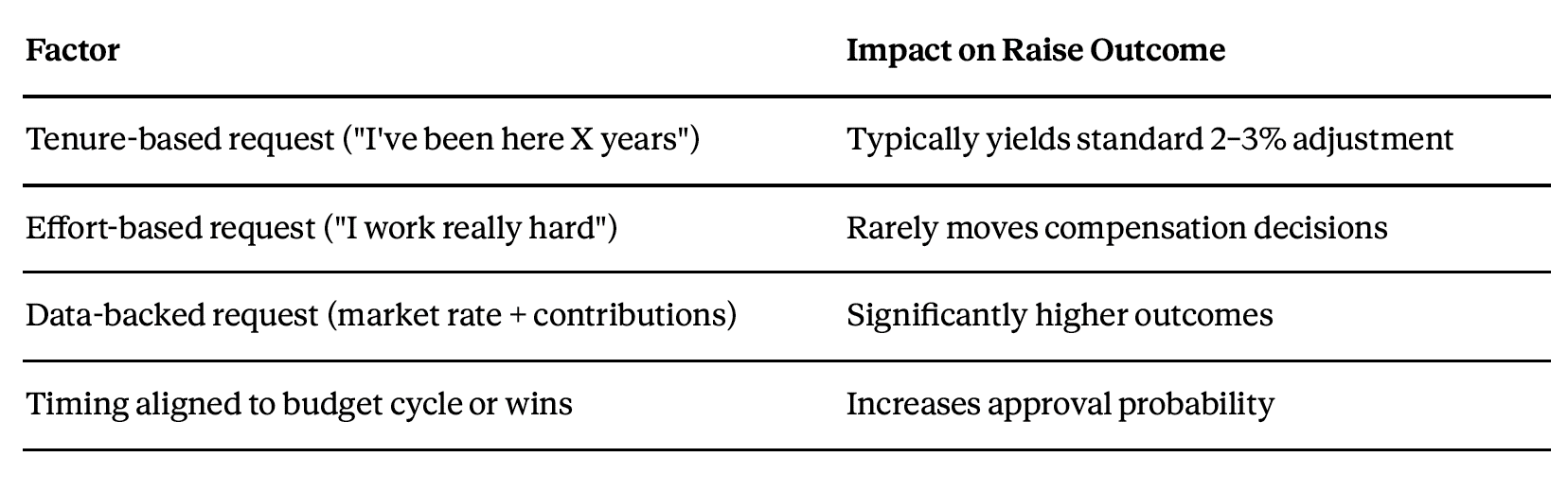
Timing matters as much as content. Asking during budget planning season, immediately after a major project win, or during a performance review window all improve your odds. Asking in January when budgets were locked in November is dead on arrival — not because your case isn't strong, but because the money is already allocated. The most overlooked variable: most EAs ask based on tenure and general effort, not contribution. That's the mistake that keeps compensation stagnant year after year.

Treat your raise like a capital allocation decision: benchmark, quantify, then time the ask.
The 3 Elements of a Raise Request That Actually Work
A raise request that gets approved has three components, and all three need to be in place before you walk into the room.
1. The number — market-anchored, not arbitrary.
Never walk into a raise conversation without a specific number or percentage, and never pull that number from thin air. Your ask should be anchored to market data for your specific role profile — not generic EA salary ranges, but compensation benchmarks that account for your executive level, industry, and strategic scope. If you haven't already, the EA Market Value Calculator will give you that number in minutes. Saying "I'd like a 12% adjustment to bring my compensation in line with market rate for my role complexity" is a fundamentally different conversation than "I think I deserve a raise."
2. The evidence — specific contributions tied to executive outcomes.
Your evidence should connect your work to outcomes your executive cares about. Not "I managed the calendar" but "I restructured your meeting cadence in Q2, which recovered approximately 8 hours per week of strategic time." Not "I handled the board prep" but "I built the board prep system that reduced your prep time from 6 hours to 90 minutes per meeting." Quantify what you can. Contextualize what you can't. Every piece of evidence should answer the unspoken question: "What would it cost to replace this person — and what would we lose?"
3. The framing — strategic partner language, not task completion language.
This is the piece most EAs miss entirely. How you frame your request signals how leadership should think about your role. If you describe your work in terms of tasks completed, you'll be compensated like a task executor. If you describe your work in terms of strategic impact — decisions influenced, risks anticipated, executive capacity expanded — you'll be compensated like a strategic partner. The language you use in a raise conversation isn't just communication. It's positioning.
This Is the Gap the Raise Request Predictor Was Built to Close
Knowing you deserve more and being able to prove it are two different things. The Raise Request Predictor takes your current compensation, role details, contributions, and timing variables and generates a predicted raise range alongside a strength assessment of your case. It evaluates your preparation across all three elements — number, evidence, and framing — and identifies where your case is strong and where it has gaps. Think of it as a dry run before the real conversation, built specifically for EAs who want to walk in with confidence backed by data, not hope. Use the Raise Request Predictor →
How to Use Your Results
Your predictor results give you more than a number. They give you a strategy. Here's how to use them. First, fill the gaps your results identified. If your case scored low on evidence, spend two weeks documenting specific contributions before scheduling the conversation. If timing was flagged, hold your request until the next optimal window — budget cycle, performance review, or post-major-deliverable. A strong case delivered at the wrong time is a wasted case.
Second, script your opening. The first 60 seconds of a raise conversation set the tone for everything that follows. Don't open with a complaint or a comparison to a colleague. Open with: "I've done a thorough analysis of my role, my market value, and my contributions over the past year, and I'd like to walk you through a compensation adjustment that reflects that." Then deliver your number, your evidence, and your framing — in that order. This isn't a discussion about feelings. It's a business case.
Third, prepare for the "not right now." If your executive can't approve a raise immediately, don't accept vague promises. Ask for a specific timeline and the criteria you'd need to meet. And if your results from the predictor showed that your overall career level exceeds your current title, a raise may not be enough — you may need a reclassification. The ElevateEA Master Strategy classes Negotiation and Positioning Track is where EAs build the full strategy for that conversation, including the follow-up that most professionals never plan for.
This Isn't About Asking for More — It's About Correcting a Gap
Reframe this for yourself: you're not asking for a favor. You're presenting a data-backed correction to a compensation gap. The EAs who approach raise conversations this way don't just get better outcomes — they change how leadership sees their role permanently. That shift from "she's asking for more" to "she's showing us what she's worth" is the difference between a one-time raise and a career trajectory change. The EA Value Suite tools are free, and always will be. For those ready to go deeper, The ElevateEA Master Strategy is where the real work begins.
But first, in order to see where you stand as a strategic partner, take the Strategic Readiness Assessment →